Focusing On What I Can Do … Instead Of What I Can’t

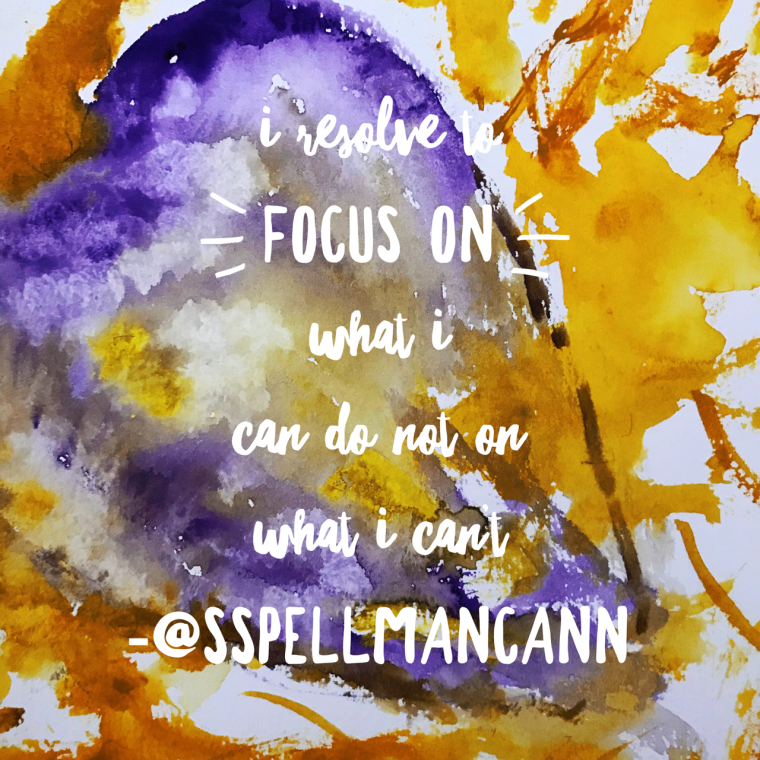
IMG_4237.PNG

This is my first blog post in a long time, I had eye surgery ( crosslinking  plus limited PRK I have keratoconus ) on November 23rd and I realized I have been focussing way too much on what I can’t do instead of what I can. So as 2018 begins, I am going to focus on what I can do instead of what I can’t!

I can ask for help when I need it ( this is so hard for a helper especially for me who is used to helping others).

I can learn to use the accessibility keys on my computer and phone.

I can write more , paint more, sing more dance more , be more ...

I can exercise more, eat healthier more, do more …

I can live more and spend more time focussing on what I can do!!!!!!!!

I can be kinder , more loving , more helpful!

I can elicit the help of others to do more of what I want to do and can do.

I need to stop that voice in my head that says I can’t drive ( for now) , I can’t see as well as I would like ( for now) , I can’t …  I can’t …

Oh yes I can, I just need to figure out how and do it. Just like how I figured out how to fix my computer at school and at home with bigger fonts. At work I asked for help, at home I googled how for my Mac system and did it! I asked for a bigger screen at work and can now easily use the scroll to increase font size to see my email. I am using the accessibility keys on my phone and computer to help me do lots of things. I can and do access online support through a keratoconus Facebook group. I am very grateful . This group and my friends and family have helped me a tremendous amount in my recovery process.

This is the first time in my life that I have lost my independence , but with help and support I can and will do lots of things … sometimes I just have to ask (even when it isn’t easy to do).

There are so many things I can do if I stay focussed on the I can! I can choose healthier options psychologically and physically. Not only can I … I will!

Anxiety: Plugged In Or Out? How Can We Help Mitigate The Effects Of Social Media On Our Kids?

Created with Wordswag

IMG_7122

guest post by: S. Helen MacKinnon

The impact that social media has on kids is undeniable. A recent article in the New York Times highlights some of the more concerning issues.

I don’t think we need  much convincing that social media has had an impact on all our lives and it is not going away anytime soon. I am a neophyte when it comes to social media, but in my work with children and their families over the past 30 years has allowed me a first hand insight into the world of children and their families.

What can we do as parents, counsellors and educators to mitigate the impact that social media is having on our young people? As in any situation where we are trying to teach children, we ourselves need to be the role model. We need to examine the message we send our kids when we are engaged in use of our own devices. What parameters do we have for ourselves when it comes to use of devices?  Do we actually have discussions with our kids about amount of usage, times and places that are no go zones for adults and kids? Do we understand the  safety issues and if not do we educate ourselves about these issues and discuss them with our children?  Yes, with any privilege comes responsibility, both for us as the adult and for our children whom we must guide to be ethical digital citizens. Don’t let their media skills fool you! Although they appear to be very savvy in the area of technology, they do not have the life experience or a fully developed brain that allows them to project the outcome of what they may see as just having a little fun or wanting to fit in. 


Teen Mental Health Programs: What Works — and Why — in Schools?

Stan Kutcher is one of the leading experts when it comes to mental health. “Stress can be good and bad, Kutcher reminded us, and we need to be able to distinguish among the three types of stress responses identified by the Harvard Center for the Developing Child”:
1) positive (daily)
2) tolerable (regularly)
3) toxic (extremely rare)
“Instead of pathologizing “stress” as “anxiety,” what children and youth need most is “inoculation” to help build a more robust stress immune system.”
How do we inoculate stress ? It starts in early childhood and continues throughout adulthood. You may wish to check out one of my previous blog posts on coping skills.

Paul W. Bennett's avatarEduchatter

Seeing some 400 teachers and school service providers flooding into the Halifax West High School auditorium on July 20, 2017 was an eye-opening experience. In the middle of the summer, they committed time to a two-day conference focusing on child and teen mental health. Led by Dr. Stan Kutcher, the Mental Health Academy was filling a real need in the school system.

With the news full of stories warning of a “mental health crisis,” teachers in the K-12 system are feeling anxious and more conscious than ever of their role in the front lines of education.  What Dr. Kutcher’s Academy offered was something of a tranquilizer because he not only rejects the “crisis” narrative, but urges classroom practitioners to develop “mental health literacy” so they can “talk smart” with students and their parents.

The fifth edition of the Mental Health Academy, initiated in 2006 by Dr. Kutcher, studiously avoided…

View original post 650 more words

If We Know How to Do It … So Will They

With the new emphasis on digital leadership , I strongly believe we as parents and educators need to learn how to develop our own digital identity. How can we truly help guide students to learn concepts of digital citizenship , becoming a digital agent, a digital interactor, etc?

How can we help young people learn how to create change in their community or how to make the world a better place online if we don’t fully understand how to do so ourselves?

Joanna Sanders asks  great questions: What does this new emphasis on digital leadership look like in the classroom? How will this benefit our students?

Learning how to be digital leaders starts the day children are born and is a never-ending lesson. How do we celebrate all the good that our youth do while teaching them about privacy, collaboration and how to vet online sources? How do we become the models they need?

Let it begin with me I say … and yes it is never too late. I started learning how to become a good digital citizen almost five years ago after joining #etmooc. I am still learning today and take every opportunity I can to learn. I have made many mistakes along the way just as I did in my own parenting, teaching and counselling , but I really try to learn from those mistakes and model for others what I am learning daily.

I think we need to give educators the time during their days to learn along with their students. Being proactive means we need to learn alongside the students trying to master these skills we want them to have. They can teach us and we can teach them. If we want to drive change through technology we need to face the fear ourselves and take positive risks online. You may wish to join communities like #immooc, where you will find educators learning every day.

Digital citizenship is essential to what educators do. Join me as I learn along the way. You may find a few tips here .

Digital Citizenship Lessons are vital. Empowering proactive digital learners is a process. If we know how to do it , they will too . What do you think?


Anxiety: Threat or Gift?

E50C37D5-24B2-4653-9B6B-40D1F4D9434E

A guest post by : S.Helen MacKinnon

Often I am asked the question, ” Why do so many kids today suffer from anxiety ?” There is no easy answer to this question but there are many more questions that we need to ask. In particular, “What is it that appears to be causing such an increase in child and adolescent anxiety? Is it related to social media?  Are we over pathologizing what may be normal reactions to stressful situations in our environment. According to Dr Stan Kutcher, a leading psychiatrist from Dalhousie University, “anxiety is a gift we have inherited from our ancestors to protect us from threat and to kick-start ambition; to fight it we have to face it.” In order to “face it” we need to  first of all understand what is happening and then respond to it in a manner which will allow us to maximize the outcome.

In other words we can use the anxiety or stress, to benefit us in our day-to-day functioning.  If we see it as a gift, we respond from a totally different  repertoire or mindset than if we see it as a threat. A gift is something positive, something we welcome, something that may make things easier for us, or at times may challenge us and help us grow. How can we work with our kids to help them understand and see anxiety as a gift? What are some strategies that will help them develop a different mindset?  Additionally, what part does social media play and are we, as parents, educators, and counsellors, contributing to the mindset of threat or gift? In my next guest post I will explore these very questions and discuss ways to unpack the gift of anxiety.


Optimism

As a Counsellor or Psychologist you are surrounded by people who are not always optimistic. Is it important that you remain optimistic? I absolutely think it is essential.

How did I get to be an optimist? For me I believe there is a genetic component to why I am the way I am. I also believe it is because I have chosen to cope in the best possible way to the many negative things that have happened in my life. It is unrealistic for me to expect that I will feel optimistic in every situation, but in every situation I attempt to look for the good and what I can learn. Does this mean I look through rose coloured glasses? No, I fully recognize that there are some situations I have not handled well or times I have felt very sad or hurt or unloved, but I have worked very hard in my life not to stay in negativity. I feel my feelings , reach out for support and move towards a more optimistic outlook.

I surround myself as much as possible with people who lift me up , not tear me down. I hope you too will find the good in each possible moment you can , not just for you, but for the people you serve or love.

Hope doesn’t mean denying reality , but looking it in the eyes and remembering the heroes and events that challenged injustice in the past.

Rebecca Solnit

A NEW TEACHER COUNSELLOR GUIDE FOR HAIKU DECK

IMG_0751

Picture Made with Haiku Deck
There are so many ways to use Haiku Deck and any teacher and counsellor can do so with students. I strongly recommend you check out the new teacher guide for step by step information that is extremely helpful. SCCHAT this is a great resource for you.

Who Matters?

cropped-img_0751.jpg

Who matters?

“Everything you do has an impact. Who you are – that you are – actually matters. In an interconnected world (the only kind we have), our actions and the actions of others are inextricably linked- we are always and forever in a dance of mutual influence with those with whom we directly and indirectly participate. It is the unavoidable reality of being social creatures, only magnified by an ever-increasingly complex and interwoven societal structure. We matter to each other.” – Paul Greiner

This sums up my feelings about so many people and about so many things. Today I sobbed as I viewed the faces of all those lost in the Vegas tragedy. They mattered to so many people and today they mattered to me even though I did not know them.

Life is truly fragile and I am ever reminded of this. I try very hard to live every day as if it is my last. Am I always successful ? No, but I really wish to live life as fully as I can, love those I can and let the people in my life that I am closest to know they matter. I don’t want to wait til someone passes away for them to know that they really matter to me.

So if you are one of those precious people in my life reading this , know that you do really matter to me and I am so grateful to have you in my life. So today and every day let others know that they matter and hopefully you too will see as Greiner says that in this complex interwoven societal structure we matter to each other.

Supervising School Counsellors

img_2792

I have been very fortunate to work with and supervise many great School Counsellors. I learn from them and they learn from me. Giving back matters and I believe seasoned School Counsellors should supervise our future School Counsellors. It helps us stay on top of our profession and allows us to be in a constant state of learning.

According to Bradley and Gould (2001) all supervision models should incororate a collaborative relationship which focuses on the indiviuality of the supervisee and one that facilitates growth and autonomy.


Some things to reflect on if you are ever in the position of supervising a student counsellor :

  • Have they developed a conceptual map with each client?
  • Which theoretical models are they adding to their toolbox?
  • What actions should they take in varing situations?
  • Are they developing the instincts and comfort level required of a beginning counsellor?
  • Are they aware of professional informed consent and record management for School Counsellors? 
  • Are they developing a leadership role within the school?
  • Are they being culturally sensitive?
  • How are they collaborating with staff? How are they optimizing their role?
  • Do they understand how a comprehensive counselling program plan is executed?
  • Have you discussed limits to their scope of practice?
  • Have you let them know they will make mistakes, misjudge situations, and lose track of sessions , but time and experience will take care of all of this.
  • Have you let them know lifelong reflection is essential?
  • Have you discussed dual roles, boundary issues and confidentiality?
  • Have you discussed ethical issues as they arise?
  • Have you modelled on a regular basis your counselling skills?
  • Have you updated read about updated models of supervision?
  • Are you in a constant state of professional development?
  • If you are a psychologist are you constantly aware of your own code of ethics?
  • Do you model and practice self- care strategies yourself?

The above are but a few thoughts to get you started. For more information on supervision and supervisory practices click here. The ATA Council of School Counsellors also offers excellent resources for a new School Counsellor.

Lessons for a new School Counsellor Lessons 11 and 12

Lesson 11

IMG_4625 2

Engagement and Collaboration

Collaboration is key to being a 21st century school counselor and working with teachers is one of the greatest collaborative efforts school counselors can make on behalf of students.  Teachers and counselors have to work together to maximize their impact on student achievement and this can be done in a variety of ways.  Whether cross-walking standards for classroom lessons or talking about individual students, this partnership is essential to helping students to be successful.

Julia Hartline

Engaging students and staff is critical when it comes to school counselling.

Student engagement is vital. How we do it can vary.   With so many students in a school you will most likely need to engage students online as well as in person. There are many ways to engage the students whether it is one to one or in groups. Learning to engage online was not easy for me , but it was super helpful. If you are a new School Counsellor #immooc  can help with this.

Here are some things I like to do and ask with students in person.

  • At the end of every session I check in with the student to see how the session went.
  • I will often ask how are you feeling about what we talked about in session today?
  • What is the one thing you will use as a result of our time together today? This allows me to gage if I have been helpful and if there is something I said that the student connected with.
  • Find ways to collaborate with students on student led initiatives on bullying etc.

Engaging Staff. Get to know your staff. Take time to have lunch with them. It is good for you to take a break and get out of your office. Helping students can be very draining at times especially if you are addressing more serious issues, so get out of your office and make time to recharge. Self-Care is important. If your staff feel you are helpful they will most likely refer a student to you.

We are all working together to enhance the success of all students so if students see us collaborating in their best interest while always maintaining confidentiality we will best be able to help them. For more information on teacher counsellor partnerships click here.

Lesson 12

Self Care… not just important Essential

School Counselling can be a very demanding career. I know it can be extremely exhausting as well as invigorating. School Counsellors often hear difficult stories and that can be energy draining. For many students Christmas can be a tough time. It is important for us to take time to heal as well.  Pay attention to how you think , feel and act.

The following article  discusses compassion fatigue and is such an important topic for any new school counsellor, but also for seasoned counsellors as well. Most importantly for all check out these self-care tips here.

Most importantly laugh and be with people who make you laugh and life as a School Counsellor will be so much more enjoyable.

Would love to hear your ideas.