Making A Difference On Line … Using Social Media to Make the World A Better Place for Educators and Students

Just for Today recognize that you can build a positive reputation. Even if you have said or done negative things in the past, start today to be honest, reliable and reputable. You can use social media to make a positive difference or a negative difference. It is all up to YOU.

Digital Citizenship has a place in every school and we need to focus on the positive aspects of the internet as well as the things that concern us.

You might want to ask yourself:

  • What are the creative opportunities on the web?
  • How can I make a positive impact on the world on the web?
  • What are the ethical dilemmas?
  • What are the rewards and the risks of being on line?

As an educator it is important for you to find great examples on the internet of students doing things to not only improve their own opportunities, but to improve the lives of those in their school, communities, and around the world. We also need to encourage students to look for these great examples as well.

I’d like to see schools focus on those students who make a difference on the internet by providing them with a scholarship that recognizes all the good they do online.

I’d also like to see every school teach students and educators about Creative Commons .

As educators we need to create our own digital footprint and model good Digital Citizenship for our students. Taking Care Of Your Digital Self highlights the importance of a positive digital presence.

When teaching Digital Citizenship we need students to recognize that they need to be responsible and learn everything they can about being a good citizen period.

We need to ask students:

  • If I were to look you up online what would I find?
  • What would you want others to find?
  • If your grandmother googled you would she be proud of what she found?
  • What is your digital tattoo? Find out more information at http://digitaltattoo.ubc.ca/

George Couros discusses the importance of students developing digital leadership skills—positive, proactive connection, cultivation, sharing, and creation of new knowledge and learning to help others.

Resources:

Be a Digital Citizen

Choose what happens next … a you tube video that is interactive for students

 Alec Couros has an excellent wiki of amazing resources to use :

My livebinder on Digital Citizenship:

My pinterest site on Digital Citizenship:

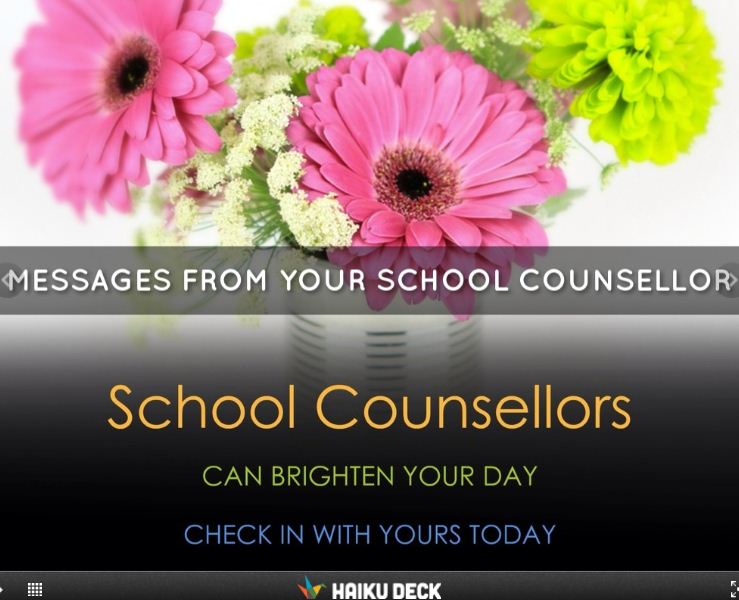
Check out my Haiku Deck on Digital Identity

Act As If …

If you have any other ideas or resources to share on this topic please do.

Being An Open Educator Is Definitely A Process

Being an Open Educator is definitely a process for me. What does being open mean? Well at this point in my life it means that I am open to learning, open to discovery, open to connecting,  open to inspiration, open to reflection, open to remaining hopeful, open to collaboration and open to finding ways that will assist and impact our students now and in the future. As a school counsellor my role is different, but being open is the same. I am connecting with diverse educators and counsellors who all want the same thing … what is best for our students. They are motivated, caring people who want to impact students in a positive way, wanting them to thrive.  They choose to be in a profession to work with students because they know that students matter and so does being an Open Educator.

Alec Couros began my thinking of being open during ETMOOC. He defines Open Teaching  in the following way:

  “Open teaching is described as the facilitation of learning experiences that are open, transparent, collaborative, and social. Open teachers are advocates of a free and open knowledge society, and support their students in the critical consumption, production, connection, and synthesis of knowledge through the shared development of learning networks.”

Part of being open is helping students and myself understand and use Creative Commons .

I believe I am becoming more open all the time by involving myself in the following:

  • Open Spokes: A fellowship for anyone who is interested in using video for reflecting on the practice of teaching and learning . Check out the following links:

The Fellowship of Open Spokes

Vote for Questions to ask these Vloggers

Become a member of Open Spokes

Here is what my fellow Vlogger  Jas has to say about being open.

My Vlog on being an Open Educator : 

I love what Sheri my fellow Open Spokes friend has to say about being open:

Open is Attitude Open is Hope

Other ways I am being Open …

I am happy to be learning along with such great Open Educators who challenge my thinking and encourage me to be better at what I do. Thanks to all of my PLN. You have helped me in the process of becoming an Open Educator and as a result I know it will positively impact students.

We All Have A Story To Tell

It is important as educators that we remember that each student comes to us with a story and even if we think we know what that story is we may not, but we should always treat that student with dignity and respect.

School Counsellors Connecting With Each Other

Image

At first when I heard about twitter I thought oh no one more thing to do and learn so why bother. I really thought I am too old to learn to use this, so what would be the point. Then everything changed. I went to a workshop by Alec Couros and was about to embark on a professional journey that would change how I connected to school counsellors and educators from around the world. Twitter and the professional network I have developed has ultimately impacted the way I practice as a school counsellor in a positive way.

As a school counsellor little did I know that opening a twitter account two years ago was one of the best ways I could develop professionally and connect with educators and school counsellors who are passionate about what they do.


What is twitter you might ask and why is it so helpful?

Twitter was founded in 2006. It is an online social networking platform that allows us to send and receive messages (140 characters). Within the body of the messages are often links to great resources or blogs or ideas that are just plain helpful. You can follow other educators and people who are associated with the ideas that are the most helpful to you. It is an extremely helpful tool that has impacted my professional life in a positive way linking me to educators who are creative, connected and willing to share ideas and resources. My PLN (personal learning network) helps me to learn almost daily. Today I need to thank @SISQITMAN for teaching me how to use word press in a more effective way. I met Glenn in ETMOOC which I found out about on twitter through @courosa which has been a gift to me as an educator. ALL the people in ETMOOC are always willing to help me as I am new to all this technology, but a most willing learner. Twitter leads to so many positive connections.

What I love about twitter:

  1. Amazing PD tool
  2. A fantastic way to connect with school counsellors and educators from all over the world
  3. A fast easy way to get access to great resources in mental health, psychology , education and school counselling
  4. Easy access to up to date resources in the field of education
  5. A great way to collaborate, connect and curate information
  6. Sharing leads to positive relationships that assist us to grow as school counsellors ( what you give , share on twitter comes back tenfold)

How can I learn more about twitter and how to use it?

  1. Ask your colleagues who are on twitter to help. Hands on lessons are the best.
  2. Go to a workshop on how to use twitter
  3. Sign up for  twitter and play and learn
  4. If you know how to use livebinders there are great resources here: Twitter … Helpful Ideas for School Counsellors
  5. Go to The Complete Manual for Understanding Twitter and learn more.

Who to follow on twitter in the School Counselling Field:

  • @SSpellmanCann            Canada
  • @Michelle0102197          Canada
  • @BoskerttheSC                  Canada
  • @TrentLangdonNL           Canada
  • @EHordyskiLuong            Japan
  • @ecmmason                        US
  • @sch_counselor                 US
  • @rsabella                              US
  • @juliataylor                          US
  • @pmsscounselor                 US
  • @Brian_Zink                  Mexico
  • @kadriblaster                Australia
  • @Teaching_Intl               China

People who resourceful and share great information:

  • @courosa
  • @gcouros
  • @rljessen
  • @karensharon
  • @grammasheri
  • @nobelknits2
  • @verenanz
  • @clhendricksbc
  • @AlisonSemen
  • @folynick
  • @SISQITMAN
  • @JeffMerrell
  • @bhwilkoff
  • @dendari
  • @mrsdkrebs
  • @gallit_z@v_lees
  • @onewheeljoe
  • @LaEducationista
  • @mbritt

Resources to follow:

  • @haikudeck
  • @scopeistech4scs
  • @psychcentral
  • @LiveBinders
  • @SCResourceCtr
  • @tellagami
  • @heretohelpbc
  • @mindcheck_ca
  • @AnxietyBC
  • @cspyyc
  • @pinterest

Hashtags to follow:

  • #cscchat              Canadian School Counsellor Chat
  • #scchat                School Counselor Chat
  • #edchat               Ed Chat
  • #cdnedchat         Canadian Educators Chat

Once you start tweeting you will love it. Those of us that have stayed with it and learned how to use it effectively absolutely love the benefits to our professional development.   Digital literacy is becoming a required skill that school counselors will benefit from . Who knows where it might lead? You’ll be a techie before you know it.  I would have never dreamed two years ago that I would be blogging, vlogging, sharing in Google hangouts or that I would be part of networks and Google communities that encourage and support each other.

Thanks to Alec Couros @courosa and everyone in ETMOOC who has helped me. I believe I am a better school counsellor with so many more resources than I ever could have dreamed of.

A big thanks also to Erin Mason @ecmmason I am connected in several ways to other school counselors who are always willing to help and point me in the right direction to resources.

Thanks to @HaikuDeck who have allowed me to share with other school counsellors, educators, and a diverse group of connected learners from around the globe who have assisted in making me better at what I do.

Connect with School Counsellors on twitter

Connect with School Counselors on Google plus Communities

Connect with school Counsellors on twitter chats

There is so much for us to learn together. I look forward continuing the journey.


Do We Really Need School Counsellors? You May Be The First One …

The First One…

Image

As a school counsellor you may be the first one

  • To listen to the story of a young man who does not believe he is good enough because his step dad who is alcoholic repeats that he is not good enough everyday in a number of ways
  • To be there when a young person comes out for the very first time
  • To listen to the dying words of a student who has cancer, but still wants to come to school
  • To listen to students who are having suicidal thoughts and don’t know how to cope or to students who need to be hospitalized and you are the first to assess the risk
  • To recognize that a student has psychosis and send them to the hospital where they get diagnosed and the family starts the process of treatment
  • To understand that a students cutting is way of coping with pain for them
  • To sit with a student as she tells her mom that she is pregnant at 15
  • To hear of a students years of repeated sexual abuse that they are now disclosing at 17 years old
  • To refer young people to a group for dealing with clinical depression
  • To work with a student who has been bullied since grade two and wants it to stop
  • To help students who feel caught in the middle because of a parents divorce
  • To recognize that a student needs treatment for their mental health
  • To get help for a young woman or young man who has an eating disorder, but doesn’t want anyone to know
  • To listen to the buried fears of a young man coping with an anxiety disorder
  • To recognize a learning disability in a young person and have them get help
  • To be present to the impalpable grief of a brother who lost his sister in a tragic accident
  • To help students face the unbearable
  • To reach out to a student with a drug and alcohol problem who feels nobody understands and encourage them to seek treatment
  • To show compassion and assist students who are suspended from school
  • To work with students who are in an unhealthy relationship and help them understand how to get help
  • To assist students with their confusion about which post secondary school to go to
  • To get students help for their academic challenges and start to achieve what they are capable of
  • To let students know that whatever they are going through they will get through it. You will be with them along the way and assist them with resources to help them when they have finished school
  • To listen to the unspoken dreams of a young person
  • To let students know they can start over
  • To reach out to the student who no one knows how to
  • To be present and teach mindfulness to the student
  • To encourage students to engage and include all students with special needs
  • To trust the student
  • To listen to their stories and share stories that can help them
  • To believe in students
  • To help students find courage
  • To not give up on the student
  • To be their champion
  • To lift them up
  • To celebrate and make them aware of their strengths
  • To help, to really help students not just survive , but thrive
  • To recognize the gifts that a student has and encourage them to utilize them
  • To give HOPE to a student who has felt hopeless
  • To be the one person that matters for that one student

The School Counsellor may just be the first one students decide to share their stories with. The student might feel safe enough in their school to trust an adult with their most precious and often their painful secrets and that person could be you. Students want help and School Counsellors are trained and want to help students. There are so many stories out there everyday and in every school all across the world that need and are being shared.

I believe School Counsellors can and are saving the lives of students.

Do we need School Counsellors? What do you think?

For any of you who are considering School Counselling, I want you to know it is the best career in the world. I also want to thank all the School Counsellors from across the world that saved a student’s life TODAY or yesterday or a year or maybe even several years ago and remind you that you do make a difference.

Always remember you may be the first one


School Counsellor Talk on Grief

Only people who are capable of loving strongly can also suffer great sorrow, but this same necessity of loving serves to counteract their grief and heals them.

– Leo Tolstoy 

School Counsellors often have to assist students with the grief process. Over the years I have seen students who have lost parents, siblings, friends, classmates and family members.

When a school experiences the loss of a student everyone feels the loss as expressed  here by a note left to a student who died.

Dear_____,

Even though we haven’t formally met, I look at your spot in English class and I am deeply saddened that you are not here with us…

It is never easy seeing a student in deep pain especially if the loss was tragic or sudden. Often times school counsellors need to ensure that they have dealt with their own issues surrounding grief so that they can best help others. School Counsellors need to be aware of vicarious trauma or counsellor burnout when assisting students who have experienced traumatic events.

Wendy Kurchak who is a retired school counsellor and now certified thantologist defines trauma loss as “a type of loss resulting from a sudden unexpected loss which is perceived as traumatic by the griever. It involves grief response + trauma response = complicated grief.” The suicide of a student is one of the most tragic a school counsellor will ever have to deal with and can most certainly bring about this kind of a response.

The school counsellor will often be dealing with the grief of several students and possibly the adults around them in any situation where a loss has affected the school community.

It is extremely important that a school counsellor takes care of their own selves as well as being present to the grief of others. To learn more about your own level of compassion fatigue go to: http://www.proqol.org/

Grief is a process and not an event. Every person’s grief is as unique as the individual or situation of loss. School counsellors may need several resources to assist students in their school community with a loss.

Students need to be reminded:

  • To grieve in their own time and way
  • That it is OK to cry and grieving comes in waves (sometimes unexpectedly through a song, a smell, or a picture. Anything can trigger moments of grief)
  • Writing in a journal, creating songs, painting, creating a space and a place to grieve may help
  • Dr. Allan Wolfelt is a leading expert in this field and offers great information
  • It is ok to talk to someone like your school counsellor, a teacher, friend, parent or your local hospice

The school counsellor can use the following sentence completions with students:

  1. Grief is …
  2. You can help me by…
  3. Something I can do to help myself is…
  4. Others should realize that I…
  5. When I am sad I …
  6. My loss feels…
  7. I don’t know what to do when I am feeling…
  8. The hardest part of my grief for me is…
  9. If I could teach someone something about grief it would be…
  10. I can turn to _________ to help me.

School Counsellors can also find resources in my live binder:

Click here:

Livebinder on Grief

If you have any grief resources you want to share , please feel free to tweet me @SSpellmanCann.

The Fellowship of Open Spokes

This video will be the first in a series of sharing our educational experience. It is my introduction. The idea was created by Ben Wilkoff @bhwilcoff Please Join us at http://openspokes.com.

Top Ten Technology Tools Every Educator and School Counsellor Should Use

Image

  1. Haiku Deck  A personal favorite of mine. This app helps students, teachers and school counsellors share stories that can make a difference.
  2. Twitter A fantastic tool for teachers and school counsellors to utilize for professional development.
  3. Livebinders A wonderful virtual 3 ring binder that helps educators and school counsellors not have to reinvent the wheel as there are so mant fantastic school counselling and educational binders already made. You can copy and use the binders available or create your own.
  4. Jux  A beautiful, visual  space that teachers and school counsellors can use to share ideas or important information. I use it for a school counselling website  www.sspellmancann.jux.com
  5. Pinterest  A wonderful place for teachers and school counsellors to find great resources and share them with othes.
  6. Google plus. Here are a few  tutorials on you tube to get you started.  
    A must site to be able to share with colleagues and those from across the world. Google hangouts are a must. 
  7. Animoto This is a nice app to use for easy videos. Teachers can sign up for a free account . Make sure you check that feature out. Check here: Animoto for Education
  8. Flipboard  A great educational and personal app that can curate information you can access easily.
  9. Tellagami   A fun easy tool that you can use to send messages to parents and students.
  10. Ted Ed An inspirational place to find videos for PD or to use with students.

For more tools go to  SCOPE School Counsellor Online Professional Exchange and  Go to:

My live binder on Resources for the School Counsellor

Have fun and if you know of any great apps or resources , please share !

Haiku Deck A Fantastic App for School Counsellors

HAIKU DECK is a fantastic app to use for School Counsellors. It is no secret that I love this app. I love this app because it is easy to use and creates professional looking beautiful presentations that I can easily use in my counselling office or as a professional development tool that I can use in presentations with other school counsellors. Stunning visuals have the ability to evoke emotion, a powerful tool for school counsellors to utilize. By being an active champion of both learning and technology school counsellors can use Haiku Deck to create amazing visuals that not only assist students in learning , but they can actually help students.

If you would like to try the web app please click  here: You are invited to try the Haiku Deck web app.

 Image                     

Click here to see this deck:

The newest version of Haiku Deck is even better than before. Check out the Haiku Deck blog for some hot tips on how to make new and exciting presentations.

The truth about stories is, that ‘s all we are”.

Thomas King

Image

School Counsellors can use this app to:

  • Share stories (while still keeping confidentiality)
  • Engage students brain to help them remember what is important
  • Share small and/or  big ideas
  • Present topics to other counsellors
  • Share ideas or topics with students ( easy to share in your office as topic starters)
  • Have students create decks on coping skills or to tell their story
  • Co create a deck with students
  • Create positive quotes and have them rotating in your office
  • Post Haiku Deck’s on your schools facebook site.
  • Tweet decks to students in your school with messages that promote school counselling
  • Tweet decks to other school counsellors.

Please feel free to share ideas you come up with so we can remix and share the best Haiku Deck’s for School Counsellors ever.

Parents might also like getting Haiku Deck’s. It is a great way to promote your School Counselling Program.

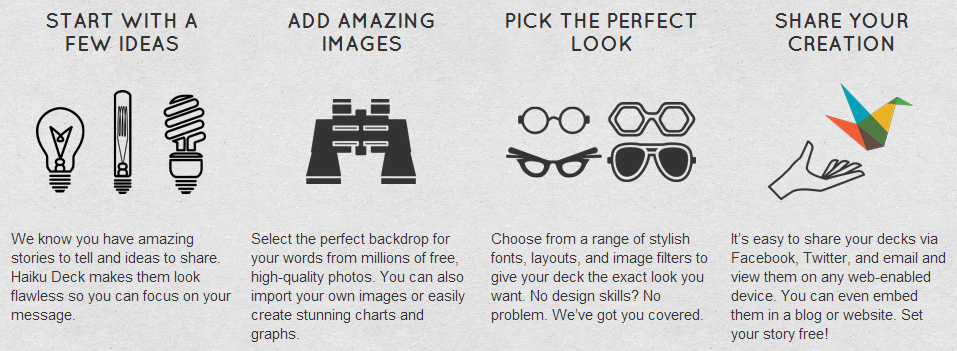
Because HAIKU DECK has a Creative Commons license, finding a picture that fits your ideas is fast and easy and as school counsellors this is extremely helpful. It’s as easy as 1-2-3 to set yourself up and share.

How to use Haiku Deck for school counsellors:

STEP 1 Go to: http://www.haikudeck.com/

STEP 2: Sign up for Haiku Deck and create a password

STEP 3: Download the app on your IPAD and start creating

Haiku-Easy-Steps

Need ideas and visuals go to the gallery where you will find all kinds of great HAIKU DECKS.

Start using Haiku Deck now and your life as a school counsellor will become be enhanced because you’ll get to share great presentations with others that look like it took you forever to create!

You can view more presentations in Haiku Deck’s Gallery, Haiku Deck’s Pinterest boards, and make sure you follow and share your experiences with Haiku Deck on Twitter (you can even tweet your fantastic presentations to them with #setyourstoryfree ) .

Check out  Susan’s Pinterest HaikuDecks for school counsellors to get you started with some ideas. 

Follow Haiku Deck on twitter @haikudeck

School Counsellors please share your counselling haikudeck’s with me on twitter @sspellmancann. I would like to pin and share with others. let’s work together to make some of the best deck’s ever for students. 

Click below to see Erin Luong’s Haiku Deck ( high school counsellor)  that she co- created with a student.


 HD Tips and tricks

YOUR School Counsellor discusses YOUR REPUTATION ON AND OFFLINE

Screen Shot 2013-01-20 at 4.10.42 PM

photo by zenobia_joy cc attribution

It is our choices … that show what we truly are, far more than our abilities.
– J. K. Rowling (Harry Potter and The Chamber of Secrets)

If I search the internet …what will I find about you?

Your reputation is very important to you on and off line so how do you keep or get a positive reputation?

  • Act As If The World Is Watching. (because they probably are) Make sure you become the person you want to be on the internet. Everything we do nowadays is recorded. It seems every move we make someone is either taking a picture or videoing us. So it is up to you to be the kind of person you want the world to see, because they just might.


Your Digital Dossier . Think about it!


  • What You Give Out Is Probably What You Will Get Back. So give out the positive vibes that you want to get back. Treat everyone as you would like to be treated on and off the internet. Put out positive messages on and off line. Flood the internet with positive posts by you. You decide what you want your reputation to be. Don’t wait for others to create it for you.
  • Self- reflect. Check out who you are on and off line.  It is always a good thing to do. Do a search on line to see what is being said about you. Google yourself on a regular basis. Build up positive stories on line if nothing is out there. Decide who you want to be and become that person. Who do you admire the most? What qualities do they have? Work on those qualities in yourself and be honest about who you are online.
  •  Be Real Be Yourself. All of us are not perfect and all we can really be is who we are, so discover the real you and make sure your reputation is really what you want it to be. If you were writing a news story about yourself what would it say? Be authentic.
  •  Live and Learn. If someone makes a bad remark about you on or off line. Don’t give it any energy. Don’t react, don’t retaliate. You know who you are and if you respond you will only fuel the fire and often that is what people want is to see your reaction. So believe in yourself and make sure you are surrounded by positive people who know who you really are. Build your allies. Block people who are inappropriate.
  •  Use Common Sense. I know this sounds easy, but some people really don’t understand this concept. Ask yourself would I make that comment to someone I respect on or off line? THINK before you post. THINK before you say something you will regret.
  • Recognize That You Are Someone Who Can Make a Difference Having a positive influence on line and off is really up to you. You can create what it is that you want. Be your own PR person. Start with making a decision to have a positive reputation.
  • Just for Today recognize that you can build a positive reputation. Even if you have said or done negative things in the past, start today to be honest, reliable and reputable.
  • Get supports Helpful and healthy relationships are important. Ask for guidance from people who know how to be ethical. Read more about being an ethical person on and off line. Learn how to have healthy relationships. Go online to research how to be the best person you can be. Take leadership courses. Volunteer. Help others less fortunate. Learn from great leaders. Who do you know that has a great reputation on and off line? Ask them how they did it. Tweet them … they just might respond.
  • Your reputation is created by you SMILE your on YOU TUBE. . How you act, what you say, what you do. It is all up to you! Build the kind of reputation you want. The world is watching now more than ever before.  
  • Safety Are you sure you are being safe on line? Ask for help if you need it.

Inspired by Janine Wariner’s talk at the Telus Convention Centre March 2010

Check out her video here:

http://jcwarner.com/speeches.html

I value digitally responsibility. I am a learner won’t you join me?

Digital Citizenship is a concept which helps teachers and technology leaders understand what students should know to use technology appropriately. But Digital Citizenship is more that just a teaching tool, it is a way to prepare students for a society full of technology. Too often we are seeing students as well as adults misusing and abusing technology. The issue is more than what the users do not know but instead what is considered appropriate technology usage.

Alec Couros


For School Counsellors Resources:

Check out the University of British Columbia’s Information on your  Digital Tattoo .

My livebinder on DIGITAL CITIZENSHIP which will be updated as we move along in the next two weeks

Videos on cyberbullying:

A very helpful resource for Creative Commons that can assist in students being digitally responsible:

http://search.creativecommons.org/

For parents:

Digital Citizenship is so important . Our digital identity begins at birth. We need to be more vigilant than ever before about becoming the person we want to be. It doesn’t mean we won’t make mistakes. It means we need to learn and grow and be responsible for who we are and will become.

Maybe because the world may be watching ,we will all become better citizens.