I AM A SCHOOL COUNSELLOR

It is National School Counselling week.

In honour I have created posters that you can feel free to download and use.
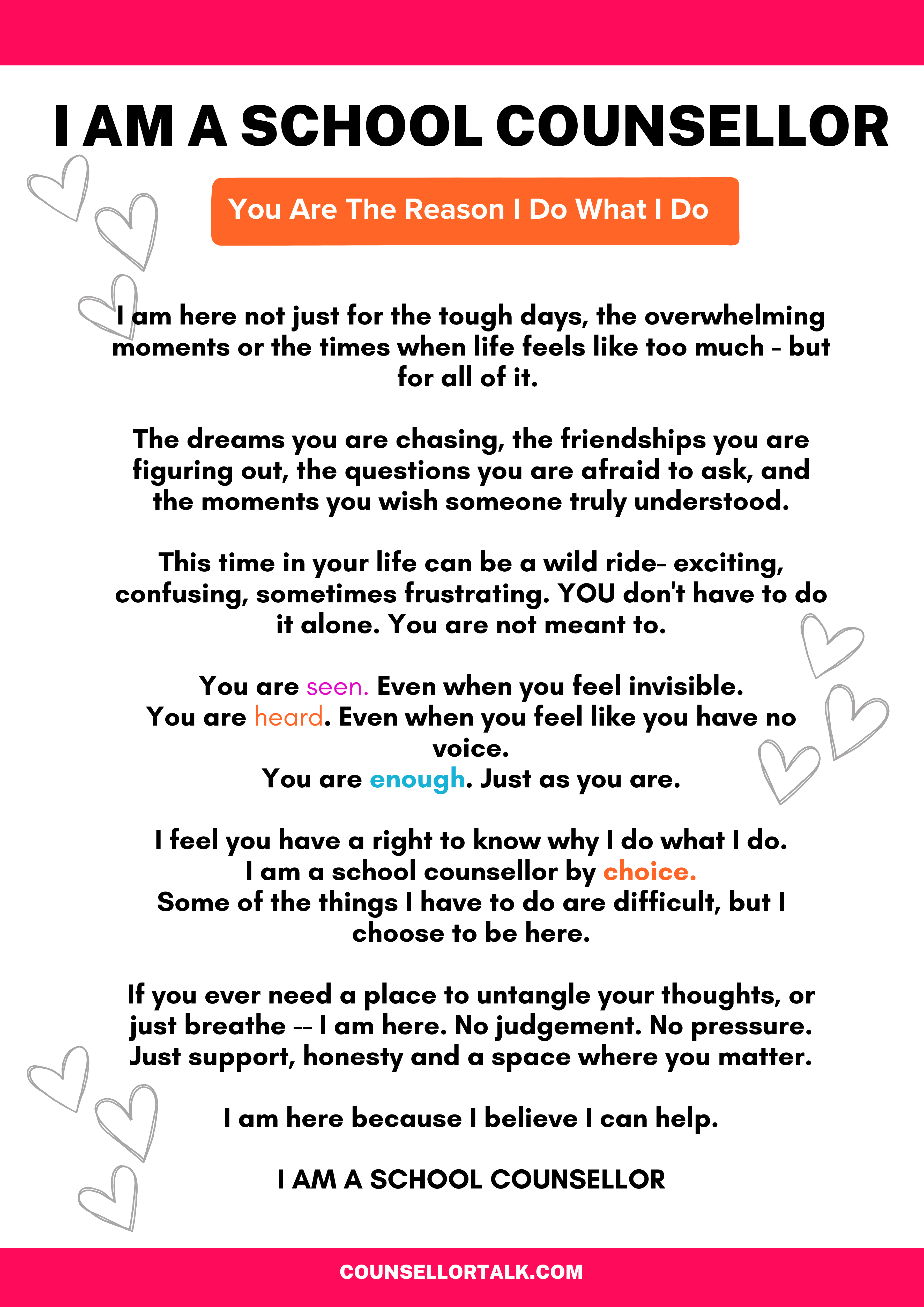
The students are why school counsellors do what they do. It has been my privilege over the years to do what I do. So if any of the below resonates with you, please feel free to use it.

I AM A SCHOOL COUNSELLOR

You Are the Reason I Do What I Do.

I am here not just for the tough days, the overwhelming moments or the times when life feels like too much – but for all of it. The dreams you are chasing, the friendships you are figuring out, the questions you are afraid to ask, and the moments you wish someone truly understood.

This time in your life can be a wild ride- exciting, confusing, sometimes frustrating. YOU don’t have to do it alone. You are not meant to.

You are seen. Even when you feel invisible.

You are heard. Even when you feel like you have no voice.

You are enough. Just as you are.

If you ever need a place to untangle your thoughts, or just breathe — I am here. No judgement. No pressure. Just support, honesty and a space where you matter.

I feel you have a right to know why I do what I do.

I am a school counsellor by choice.

Some of the things I have to do are difficult, but I choose to be here.

I am here because I believe I can help.

I care; I mean I really care about young people. I do my best to help as many students as I can, being advocates for you in school.

I want you to know

What you do with your life is up to you.

You are in charge of you. I am here to help you reach your full potential. I will insist that you learn. It is your ticket to absolute freedom.

Be all that you can be!

It isn’t easy being a teenager; even I can get frustrated with your raging hormones. You are growing and changing. I understand that. Take responsibility for your life and your actions and your teachers and others will respect you.

I do care, don’t ever forget it.

That’s why I am here.

That’s why I choose to do what I do.

I want you to know YOU can

Stop…Think…Speak

Remember, your thoughts lead to feelings lead to your actions. Change your thinking and you will have control of your life.

No matter what anyone else says or does to you, you are a worthwhile person. A gift from God. You are somebody.

There will be times during your school experience where negative things are said or done to you. You may experience painful times. Life can be difficult. It’s not what happens in your life that matters, but how you choose to respond to it.

What you put into school is what you will get out of it.

You can make a difference. If you choose to share a part of yourself with me, we can work together to make changes in your life. Your school experience will become everything you hoped it could be. Get involved and you will feel better about yourself.

Give life a chance.

One of the easiest things to say and one of the most difficult things to do are to live one day at a time. If you can master letting go of the past, not worrying about the future, but living each day to the fullest, then you will have lived a great life full of few regrets.

Be patient.

Change takes time. Let yourself grow. We all can change if we have the courage and the wisdom.

I have faith in you.

NEVER GIVE UP! Have Hope! Become the gift from God you were meant to be and you pass it on to others.

I hope your life is everything you ever dreamed it to be.

I am grateful if I am a small part of your journey.

REMEMBER

You are STRONGER than you think. BRAVER than you feel. You are more CAPABLE than you think. You are NEVER ever ALONE.

Come as you are.  I’ll be here for you.

We Have A Few Ideas and We Hope You Can Make Them Better

Helen and I are launching our new website very soon and we hope you will join us on our journey. We will be offering workshops for mental health professionals and teachers.

Larry Ferlazzo @larryferlazzo.bsky.social is the impetus for this blog post. He expressed the idea that we may have a few ideas to share , but more importantly we hope you can make them better.

Helen and I have been educators , school counsellors and psychologists and along the way we have learned a thing or two. We are hoping that when you attend our workshops you will gain a few ideas and make them your own, yes make them even better as we know you will do.

So join us on this next chapter where we share tips, tools and technology that can impact the work you do.

Susan Spellman Cann Helen MacKinnon

Registered Psychologists

Connecting with Counsellor Talk:

For workshops  or PD contact counsellortalk@gmail.com

Amazon: Where you can purchase the book Counsellor Talk: Connecting Through Creative Counselling Techniques

Website: Counsellor Talk : Connecting Through Creative Counselling Techniques

Facebook: Counsellor Talk

Instagram  @counsellortalkcanada

You Tube Counsellor Talk – YouTube

Seize The Moments

As I age I don’t enjoy life any less, but I am ever reminded to seize the moments as life is short. Yes, we all know that, but do we really do it. I consciously attempt to seize as many moments as possible. It’s so easy to let the moments slip by, so I often get up early to enjoy the sunrise, just sitting and enjoying the moments.

I almost always start my day off by going for a walk even before I eat. Sometimes I don’t feel like it , but I always feel better afterwards.

I love spending time with friends like my dear friend Helen where we have these , “Stop Right Here” moments, Moments we love to just turn around in our car to catch a moment we might not have otherwise or to take in the beauty that we take for granted. We spend a day stopping wherever we want discovering new adventures or places we have never seen before.

Speaking of friends, what about those girlfriend weekends where you celebrate your friendships. There can never be enough of those.

Or the special let’s just sit around the table forever and laugh and reminisce or talk about what is important in each other’s lives. I love those moments and memories.

So just for today , be intentional about seizing your moments wherever and however you can.

Copious Ways of Coping

Dealing with our distress is important to maintaining mental well-being and can be challenging. However, having a set of effective coping strategies can make a significant difference. We all need them young and old. You can build and use your own Coping Toolkit to navigate daily stressors and improve your overall mental health and wellbeing. Here are a few that I put together from A- Z to get you started. What works for you may not work for someone else.

The Feelings Thermometer

A feelings thermometer can help young people identify how they are feeling and will assist others in helping youth manage their emotions effectively. The thermometer is a simple tool that helps you gauge your current emotional state. Are you feeling calm and collected, or are you on the verge of a meltdown? Identifying this can help you choose the right coping strategies. If a young person is on the verge of a meltdown the way you help them will be much different than if they are at a 4-5 on a scale of 10.

Building Your Coping Toolkit

Your Coping Toolkit should include personalized strategies that work best for you. Here is an online Coping Toolkit that I created in Google Slides that you can use with youth.

Daily Reminders

Consistency is key when it comes to coping strategies. Here are some daily reminders to keep you on track:

  • Reframe Your Thoughts: Practice turning negative thoughts into positive ones. This can help shift your perspective and reduce feelings of distress.
  • Practice Gratitude: Take a moment each day to reflect on what you’re grateful for. This simple habit can improve your mood and outlook on life.

Healthy Coping Mechanisms

Identifying healthy ways to cope with distress is crucial for long-term well-being. Here are some methods to consider:

  • Journaling: Writing down your thoughts and feelings can be a therapeutic way to process emotions.
  • Healthy Distractions: Engage in activities you enjoy, such as reading a book , playing sports , creating art or watching a favorite show, to take your mind off stressors.
  • Relaxation Techniques: Techniques such as progressive muscle relaxation and guided imagery can help lower stress levels.

Reducing Carried Distress

Carrying around unresolved distress can be burdensome. Here are a few strategies that may lighten your emotional load:

  • Set Realistic Goals: Break down tasks into smaller, manageable steps to avoid feeling overwhelmed.
  • Self-Compassion: Be kind to yourself and acknowledge that it’s okay to have off days.
  • Seek Professional Help: Talking to a therapist or school counsellor can provide you with the help you may need. It’s a strength to reach out.

I love this podcast by Andrew Huberman as he interviews Dr. Victor Carrion on PTSD in youth. They are strategies we can all use with youth.

If you aren’t listening or paying attention to all the amazing interviews by @hubermanlab you may want to start today. Below are some of my adaptations of what Dr.Carrion had to say in his interview with Andrew Huberman. I love how Huberman shares all the fabulous resources on his web page. It’s a must go to space for all counsellors.

By incorporating coping strategies into your daily life, you can create a robust Coping Toolkit that helps you manage stress and enhance your mental well-being. Remember, it’s about finding what works best for you and practicing these techniques consistently. For more coping skills you can check out our book Counsellor Talk: Connecting Through Creative Counselling Techniques. There are copious resources inside.

Feel free to share your own coping strategies in the comments below. Let’s support each other in building healthier, happier lives!

When You Impact A Life: The Ripple Effect

Do you ever stop to really think about the impact you have? I know that as a teacher, counsellor and therapist, I was always too busy to stop and reflect on the impact I was having unless I received a letter or note reminding me that I indeed did something that mattered. It’s often said that a single act of kindness or something that you say (words do matter) can set off a chain reaction, touching countless lives in ways we might never fully comprehend. Imagine standing on the beach as the sun sets, the waves gently lapping at your feet. Each wave represents a life you’ve touched, and the endless ocean symbolizes the infinite connections that stem from that impact. As a school counsellor therapist or teacher, this is the essence of your work—creating ripples of positive change.

You Don’t Just Impact One Life

When you really think about the times you extend a helping hand, offer a listening ear, or share a moment of understanding, you begin to see the ripples that go far beyond that initial interaction. These ripples spread out, affecting not just the person you directly helped, but also everyone they come into contact with. For example, helping a student navigate their anxiety not only empowers them. but also brings a sense of calm to their family and friends who witness their growth and resilience.

You can Have a powerful Impact That Isn’t always EASY to measure

Think about the joy in a group of friends’ faces as they gather for a photo, especially at graduation time. Your influence on one person in that group can enhance the happiness and well-being of everyone else there. It’s a beautiful, interconnected web of relationships and experiences that you may not take time to really think about. By fostering a supportive environment for one student, you help create a ripple of positivity that extends to their entire social circle.

The warmth and support you offer to just one individual can strengthen family bonds, provide guidance, and foster a sense of community. When a person feels supported and understood, they are more likely to extend that same kindness and understanding to their family and peers, perpetuating a cycle of compassion.

Each moment of support and encouragement you provide is a gift that keeps on giving, as it inspires people to pursue their dreams and share their passions with the world. You may never hear about it, but it’s there.

In the end, the impact you have is immeasurable. So, continue to do what you do one person at a time. Your role as a school counsellor, therapist or teacher is not just a job; it’s a mission.

Your journey of impact starts each day, and the ripples you create will touch countless hearts and help you affirm that what you say and do matters.

Pillars of Mental Strength

In life, we often encounter ups and downs that can challenge our mental fortitude. It is during these times that our mental strength comes into play. The ability to navigate through life’s challenges, bounce back from setbacks, and stay focused on our goals isn’t always easy.

It’s not about ignoring feelings or suppressing emotions, but about developing a helpful set of skills and attitudes that can help us manage our thoughts, regulate our emotions, and behave productively even in the face of adversity.

Four key pillars of mental strength that could be helpful to you are self-awareness, optimism, adaptability, and resilience.

Self-awareness involves understanding your strengths, weaknesses, and triggers. It means being aware of your thoughts, feelings, and behaviours, and how they might be affecting your life. We could all use a little self-awareness and reflection. Journaling is one way to become more self-aware and our book, Counsellor Talk offers you an opportunity to dig deep and explore your thoughts and feelings. Self-awareness is the first step in building mental strength because, without this awareness, it’s difficult to identify areas of improvement. When we understand our strengths, we can leverage them to our advantage. Staying focused on our strengths is so important. When we understand our weaknesses, we can work on improving them. When we understand our triggers, we can develop strategies to manage them.

Optimism, the second pillar involves maintaining a hopeful outlook even in challenging situations. Optimism doesn’t mean ignoring the reality of your situation, but rather choosing to focus on the most hopeful aspects. It’s about expecting the best possible outcome and viewing the glass as half full rather than half empty. I believe there are some genetic aspects to optimism, however it is a skill that can be learned. Research shows that optimistic individuals are more likely to persevere in the face of adversity, have better health outcomes, and live longer lives. By developing a positive mindset, we can enhance our overall well-being.

Adaptability, the third pillar of mental strength means being able to embrace change and adjust strategies when needed. Life is definitely unpredictable and the ability to adapt to new situations or changes is crucial in building mental strength. Adaptable individuals can adjust their thinking and behaviour to meet the demands of different situations. They are open to new ideas, willing to take risks, and able to learn from their experiences. By being adaptable, we can navigate through life’s challenges with more ease and confidence. It is a skill we can learn to make life more manageable.

Resilience, the last pillar is where we learn from setbacks and view them as growth opportunities. Resilience is the ability to bounce back from adversity, trauma, or failure. It’s about being able to pick yourself up, dust yourself off, and keep going.

As parents and counsellors we not only need to model resiliency skills we also need to let our young people experience failure and learn from it. Resilient individuals are not immune to difficulties, but they can healthily cope with them. They view setbacks as temporary hurdles rather than permanent roadblocks. By fostering resilience, we can enhance our mental strength and improve our capacity to recover from life’s challenges.

Mental strength is not something we’re born with, but something we can cultivate over time. By building self-awareness, maintaining an optimistic outlook, embracing adaptability, and fostering resilience, we can navigate life’s challenges with more confidence. Remember, it’s not about being strong all the time, but about knowing how to tap into your strengths when you need the most.

For more information on mental strength and other related topics, you can also follow us on Facebook by searching for ‘counsellor talk’, and on Instagram at @counsellortalkcanada. What pillar of mental strength would you add?

Who Doesn’t Need A Counselling Skills Toolbox?

We all have our unique paths to walk, and sometimes, we could use a little help. That’s where Counsellor Talk can step in, providing the tools to navigate your emotions and experiences and help you to understand yourself better.

Being open to counselling as a way to transform your life is a good idea and we have loved helping those that have crossed our paths over the years.

Counsellor Talk Is written with counsellors in mind. However, teachers and those working with youth or adults can utilize the ideas too. Several handouts will work with people at every age level. There is no shortage of ideas to get those counselling ideas flowing to help others.

Who doesn’t need a counselling skills toolbox? A few ideas you can put in your toolbox are:

Just for Today

Start each day in a positive way. Accept yourself exactly as you are, knowing that you are enough.

When we celebrate our shared humanity and think of ways to help not only ourselves but find ways to help others and make the world a better place, we heal. All of us can do anything just for today.

Life is Better When…

We focus on gratitude rather than grievances. We treat ourselves with the same compassion and care that we give to others. So let go, embrace your flaws, and listen to the whispers of our intuition guiding you on your journey.

Challenge Yourself to…

Be more, do more, live more. Try something new, and learn to play more. Remember, by focusing on your strengths, you gain personal power. By reframing your thoughts, your worldview can change. By listening with an open mind and an open heart, you learn more.

Something You Might Need to Hear Today

You matter. You are a unique and valuable individual, worthy of love, respect, and acceptance. Like a butterfly emerging from its cocoon, you are continuously evolving and adapting to change.

Something I Need to Understand

Feelings aren’t facts. They are neither right nor wrong; they just are. Self-awareness is the first step towards personal growth. Exploring your thoughts, feelings, and behaviors can help you better understand yourself and your needs. Challenging negative thought patterns and cultivating positive affirmations can lead to a more positive outlook on life.

Remember, you are meant to be here; you have a purpose.

Well-being Tip

Treat yourself right; it’s time for a spa day so go ahead and take one. An economical version, relax in a bubble bath and let your worries unwind. Make time to have friends over for dinner. Enjoy the moments, make memories, and bring more joy into your day.

Rediscover simple pleasures and leave your phone behind. Find solace in simplicity; it’s your special place.

Final Thoughts

If you don’t like your story, rewrite a new chapter. Create the life you desire. Strive to thrive rather than just survive and shower yourself with self-love.

As Ronna Jevne says, “Hope is the small voice in our heart that says yes to life.” As your journey continues, remember, that you are not alone. Counsellor Talk, hopes you connect and collaborate with others every step of the way.

For more insights and tips, you can check out our book.

Counsellor Talk : Connecting Through Creative Counselling Techniques

It has been a process, to say the least in creating this book, but we are so happy it is here. So much learning as we did not hire anyone to help us. We look forward to sharing Counsellor Talk with you and are so grateful for all the input from others.

We believe our book is real and relatable, and we hope it will be truly inspiring. We invite you to explore a multitude of ideas that we hope will get your creative juices flowing.

Get ready to embark on a journey where we will share several tips, tools, and techniques to empower you in finding your path, and discovering what works best for you and your clients.

As psychologists, we understand the power of connection. The therapeutic alliance is the foundation upon which healing is built, the glue that binds us together in our shared humanity. In “Counsellor Talk,” we’re offering you the tools to deepen those connections, breathe new life into your practice, and embark on a journey where healing isn’t just a destination. You will use many of the ideas as jumping-off points to meet the needs of your particular clientele.

So, grab your favorite mug, brew a cup of your preferred beverage, (we prefer a cup of calming tea), and settle in. Let’s explore together, heart to heart. We hope you will rediscover the magic of counselling, not as a clinical exercise, but as an art— a place where ideas flow to meet the needs of those entrusted to your care. 

Throughout “Counsellor Talk,” you’ll find practical tips, creative exercises, handouts, and ways to integrate technology into your practice. From mindfulness techniques to expressive tools via the arts, from narrative therapy to using technological tools —we’re here to help you expand your toolkit, inspire you to think outside the box and embolden you to make a real difference in the lives of those you serve.

 “Counsellor Talk” isn’t just about the nuts and bolts of counselling—it’s about the heart and soul behind the practice. It’s about rediscovering the joy in your work and rekindling the passion for helping others which is the first thing that drew you to this field.

What inspired us to write “Counsellor Talk” was you—the counsellors, the school counsellors, the therapists, and the healers who devote their lives to helping others. This book has been over 30 years in the making, but life got in the way. So here we are finally sharing some of our ideas and inspiration with you by never giving up our goal and publishing our first book. The journey continues as we go on the road to support you with in-depth workshops based on our book Counsellor Talk.

As two psychologists with over 60 years of combined counselling experience, we wish to inspire the next generation of counsellors as well as rejuvenate those seasoned professionals.

In writing this book we hope to pass on our passion and love of counselling. It has been the best part of our professional lives.

Virtual Calming Spaces Counselling Office

Who doesn’t want to find a calm space? Join in with the many links you will find here. Enjoy and feel free to copy and make your own.