
When You Impact A Life: The Ripple Effect

Do you ever stop to really think about the impact you have? I know that as a teacher, counsellor and therapist, I was always too busy to stop and reflect on the impact I was having unless I received a letter or note reminding me that I indeed did something that mattered. It’s often said that a single act of kindness or something that you say (words do matter) can set off a chain reaction, touching countless lives in ways we might never fully comprehend. Imagine standing on the beach as the sun sets, the waves gently lapping at your feet. Each wave represents a life you’ve touched, and the endless ocean symbolizes the infinite connections that stem from that impact. As a school counsellor therapist or teacher, this is the essence of your work—creating ripples of positive change.

You Don’t Just Impact One Life

When you really think about the times you extend a helping hand, offer a listening ear, or share a moment of understanding, you begin to see the ripples that go far beyond that initial interaction. These ripples spread out, affecting not just the person you directly helped, but also everyone they come into contact with. For example, helping a student navigate their anxiety not only empowers them. but also brings a sense of calm to their family and friends who witness their growth and resilience.

You can Have a powerful Impact That Isn’t always EASY to measure

Think about the joy in a group of friends’ faces as they gather for a photo, especially at graduation time. Your influence on one person in that group can enhance the happiness and well-being of everyone else there. It’s a beautiful, interconnected web of relationships and experiences that you may not take time to really think about. By fostering a supportive environment for one student, you help create a ripple of positivity that extends to their entire social circle.

The warmth and support you offer to just one individual can strengthen family bonds, provide guidance, and foster a sense of community. When a person feels supported and understood, they are more likely to extend that same kindness and understanding to their family and peers, perpetuating a cycle of compassion.

Each moment of support and encouragement you provide is a gift that keeps on giving, as it inspires people to pursue their dreams and share their passions with the world. You may never hear about it, but it’s there.

In the end, the impact you have is immeasurable. So, continue to do what you do one person at a time. Your role as a school counsellor, therapist or teacher is not just a job; it’s a mission.

Your journey of impact starts each day, and the ripples you create will touch countless hearts and help you affirm that what you say and do matters.

Navigating Anxiety | Counsellor Talk

Does your mind sometimes feel like a tangled ball of yarn, with worries and fears pulling you in every direction? You’re not alone. Anxiety is a common emotion we all experience, but when it overstays its welcome, it can disrupt our daily lives.

Understanding Anxiety

Imagine anxiety as a fire alarm in your brain. It’s there to alert you of danger, but sometimes it goes off even when there’s no real threat—like when you burn toast. When anxiety becomes frequent, intense, and prolonged, it can interfere with your daily routine and overall well-being. Recognizing this is the first step towards managing it.

Anxiety is a common emotion, but when it becomes persistent, it can interfere with daily life. Frequency, intensity, and duration matter. If you’d like to understand more go to AnxietyCanada.com

Avoidance Behavior: The Sneaky Culprit

Avoidance might seem like a quick fix, but it’s a sneaky culprit that can make anxiety worse. Ask yourself: Are you dodging certain situations because of irrational fears? If the answer is yes, it’s a sign you need to address the root of your anxiety. Talking to a doctor or a counsellor can be incredibly helpful.

Stay Connected

Humans are social creatures, and sharing our feelings can be a powerful antidote to anxiety. I walk and talk almost daily with colleagues and friends and it is amazingly helpful to deal with a range of emotions. Whether it’s chatting with friends, joining a support group, or even writing in a journal, expressing your thoughts can reduce the feelings of isolation that often accompany anxiety.

Everyone Experiences It Differently

Just because you’re feeling anxious doesn’t mean you have an anxiety disorder. It’s essential to understand that everyone experiences anxiety differently. Educate yourself about anxiety and mental health to better navigate your emotions. Check out mentalhealthliteracy.org for more fabulous resources.

Professional Treatment: Your Toolbox

When anxiety becomes too much to handle on your own, it’s time to explore professional treatment options. Cognitive Behavioral Therapy (CBT) and medication are two effective methods for treating chronic anxiety. Finding the right approach might take some time, but it’s worth the effort to explore different options and regain control over your life.

Anxiety doesn’t have to rule your life. By understanding it, addressing avoidance behaviors, staying connected with others, and seeking professional help when necessary, you can manage anxiety and lead a fulfilling life. Remember, you are not alone on this journey.

For more resources check this out and for tips on well-being, visit counsellortalk on Facebook and join the conversation on Instagram @counsellortalkcanada.

Enjoy every second of every day and take care of yourself!

Note: This blog post is for informational purposes only and does not substitute professional medical advice.

Mother’s Day Isn’t Always Easy

Mother’s Day, for many, it’s a day filled with joy, love, and gratitude for the incredible women who have shaped our lives. But for others, it can be a day tinged with sadness, longing, or even pain. Whether you’re grieving the loss of a mother or mother-in-law like me, navigating a strained relationship, experiencing or have experiencing infertility in the past, you are not alone.

First and foremost, it’s okay to feel whatever you’re feeling. Emotions are complex and valid, and there’s no right or wrong way to navigate them, especially on a day like Mother’s Day. If you’re struggling, give yourself permission to acknowledge and honor your emotions without judgment.

If you’re grieving the loss of a mother or a child, know that it’s natural for this day to bring up feelings of sadness, nostalgia, or even anger. Take the time to remember and cherish the memories you shared, and allow yourself to grieve in whatever way feels right for you. Surround yourself with supportive loved ones who can offer comfort and understanding. Be extra kind to yourself today.

For those who have faced infertility or struggling to conceive, Mother’s Day can serve as a painful reminder of unfulfilled dreams and desires. Know that your worth as a person is not defined by your ability to have children. Your journey is valid, and there is hope and support available to you, whether it’s through therapy, support groups, or connecting with others who understand your experience.

If you’re navigating a strained relationship with your mother or your children, remember that boundaries are important for your emotional well-being. It’s okay to prioritize your own needs and set boundaries that protect your mental health, even if it means stepping back from certain traditions or interactions on Mother’s Day. Esther Perel shares her experience with a post called I miss you and I’m happy you’re gone.

Ultimately, remember that you are worthy of love and compassion, regardless of your circumstances. If Mother’s Day feels difficult for you, know that it’s okay to create your own rituals and traditions that honor your experience and provide comfort. New rituals can be soothing and helpful. Whether it’s going for a walk and noticing all the beauty around you, practicing self-care, or simply being kind to yourself, prioritize activities that nourish your soul and bring you joy and peace.

And to those who are celebrating Mother’s Day with joy and gratitude, remember to extend empathy and compassion to those who may be finding this day difficult. Reach out to loved ones who may be struggling, offer a listening ear, and hold space for their emotions without judgment.

Above all, remember that you are never alone. Lean on your support network, seek professional help if needed, and remember that it’s a day.

On this day I’m pausing to think of all those who struggle for all the possible reasons and sending you as much positive energy as I can muster up.

Pillars of Mental Strength

In life, we often encounter ups and downs that can challenge our mental fortitude. It is during these times that our mental strength comes into play. The ability to navigate through life’s challenges, bounce back from setbacks, and stay focused on our goals isn’t always easy.

It’s not about ignoring feelings or suppressing emotions, but about developing a helpful set of skills and attitudes that can help us manage our thoughts, regulate our emotions, and behave productively even in the face of adversity.

Four key pillars of mental strength that could be helpful to you are self-awareness, optimism, adaptability, and resilience.

Self-awareness involves understanding your strengths, weaknesses, and triggers. It means being aware of your thoughts, feelings, and behaviours, and how they might be affecting your life. We could all use a little self-awareness and reflection. Journaling is one way to become more self-aware and our book, Counsellor Talk offers you an opportunity to dig deep and explore your thoughts and feelings. Self-awareness is the first step in building mental strength because, without this awareness, it’s difficult to identify areas of improvement. When we understand our strengths, we can leverage them to our advantage. Staying focused on our strengths is so important. When we understand our weaknesses, we can work on improving them. When we understand our triggers, we can develop strategies to manage them.

Optimism, the second pillar involves maintaining a hopeful outlook even in challenging situations. Optimism doesn’t mean ignoring the reality of your situation, but rather choosing to focus on the most hopeful aspects. It’s about expecting the best possible outcome and viewing the glass as half full rather than half empty. I believe there are some genetic aspects to optimism, however it is a skill that can be learned. Research shows that optimistic individuals are more likely to persevere in the face of adversity, have better health outcomes, and live longer lives. By developing a positive mindset, we can enhance our overall well-being.

Adaptability, the third pillar of mental strength means being able to embrace change and adjust strategies when needed. Life is definitely unpredictable and the ability to adapt to new situations or changes is crucial in building mental strength. Adaptable individuals can adjust their thinking and behaviour to meet the demands of different situations. They are open to new ideas, willing to take risks, and able to learn from their experiences. By being adaptable, we can navigate through life’s challenges with more ease and confidence. It is a skill we can learn to make life more manageable.

Resilience, the last pillar is where we learn from setbacks and view them as growth opportunities. Resilience is the ability to bounce back from adversity, trauma, or failure. It’s about being able to pick yourself up, dust yourself off, and keep going.

As parents and counsellors we not only need to model resiliency skills we also need to let our young people experience failure and learn from it. Resilient individuals are not immune to difficulties, but they can healthily cope with them. They view setbacks as temporary hurdles rather than permanent roadblocks. By fostering resilience, we can enhance our mental strength and improve our capacity to recover from life’s challenges.

Mental strength is not something we’re born with, but something we can cultivate over time. By building self-awareness, maintaining an optimistic outlook, embracing adaptability, and fostering resilience, we can navigate life’s challenges with more confidence. Remember, it’s not about being strong all the time, but about knowing how to tap into your strengths when you need the most.

For more information on mental strength and other related topics, you can also follow us on Facebook by searching for ‘counsellor talk’, and on Instagram at @counsellortalkcanada. What pillar of mental strength would you add?

Seeing Life Differently: Never Take Life or Your Vision for Granted

Life is complex for most people. If you are fortunate and grateful to reach my age you never take life or anything for granted. You live, truly live life to the best of your ability.

Seeing Change as an Adventure

When I first started having vision issues, I felt like I was stumbling through a foggy maze. It was scary, frustrating, and honestly, pretty overwhelming. I remember coming back from the ophthalmologist and thinking if I eventually need a seeing-eye dog, so be it. The reality of that is something different.

Over time, I realized that this new chapter wasn’t the end of my story—it was just a plot twist. Embracing change is what I attempt to do on a daily basis. I have keratoconus – specifically pellucid marginal degeneration. I also have herpes eye disease , and cataracts and have had posterior vitreous detachments in both eyes (very common in those of us past 60 years of age).

I wear sclerals which have been life-changing for me, glasses do not work anymore (except for readers). I will eventually need a corneal transplant, but for now, if the eye herpes stays at bay my corneas will be ok.

What Has Helped Me

I have always had an optimistic mindset, so that has helped tremendously, but connecting with others who also have the same eye condition has really helped. I belong to an online support group for keratoconus and have a good friend with the exact same eye condition. You are not alone. It seems there is a support group for almost every condition out there. Of course, having a great optometrist and an ophthalmologist helps. I am fortunate to have both of those.

Be My Eyes  Be My AI

If you haven’t heard of it, the BE MY EYES app, Be My AI is a must.

As an optimist, I am hopeful that technology will help us live our best life. 

Who knows what is next? We live in a different world than we did ten years ago. Hope is what keeps me going every day. If you know of any great resources that can assist people who are blind or have low vision feel free to share them.

Lean on Your People

Here’s the thing: you don’t have to go through this journey alone. Seriously, reach out to your friends, your family, and those who get you. As a psychologist, I know it is a strength to reach out. We all need support at some time in our lives.

It’s amazing how much love and support you’ll find when you let people in.

Finding Silver Linings

Okay, let’s keep it real. Losing your sight sucks. There’s no sugarcoating it. But you know what? Even in the darkest moments, there’s a flicker of light. Maybe it’s finally learning to slow down and savor life’s simple pleasures. Or discovering a newfound appreciation for the beauty of sound, touch, and smell. It’s all about finding those silver linings and holding onto them for dear life. Sometimes it’s easier said than done, but if you take each day and savour as many moments as possible, it makes life easier.

Losing your sight might feel like the end of the world for you, and no one truly understands unless they have been through it in some form or another, but trust me, you can cope and live a fulfilling life no matter what life throws at you.

I am so grateful that I wake up each day and can embrace the good around me and hope you too can connect with others that help make life better. 

So as you navigate the twists and turns of life, seize as many moments as possible, love those around you, spend as much time with friends and family that lift you up as you can and never take your life or your vision for granted.

Performance Anxiety

We feel so lucky to work with talented youth, like the Young Canadians of the Calgary Stampede. Their dedication and creativity are awe-inspiring, and we’re grateful for the opportunity to share their tips and experiences with you!

Performance anxiety is a personal experience that can range from minor jitters to overwhelming nerves. Here are some ideas we believe can help:

  1. Confront Negativity: Recognize and address any negative thoughts or perceptions about performing. Accept the need for change and work on these one at a time.
  2. Cultivate Confidence: Believe in your unique gift and your purpose in performing. Slow, deep breathing, like square breathing, can help keep you centered.
  3. Challenge Negative Thoughts: Shift your inner dialogue from “I can’t” to “I can.”
  4. Stay Engaged: Focus on the music or your performance rather than potential mistakes.
  5. Embrace Excitement: A mindset of excitement can actually enhance your performance. Let those butterflies work for you!
  6. Progress Takes Time: Remember the 10,000-hour rule. It takes time to master your craft, so be patient and kind to yourself.
  7. Rest Well: Prioritize rest before and during performances. It makes a significant difference.
  8. Stay Positive: Keep a hopeful mindset.
  9. Visualize Success: See yourself as a star performing flawlessly.
  10. Be Authentic: Journal your fears and stay true to yourself.
  11. Stick to Routines: Consistency can offer comfort and help ease anxiety.
  12. Normalize Anxiety: You’re not alone. Chat with a friend to share strategies and support.
  13. Embrace Imperfection: Perfection isn’t the goal—focus on your growth and journey.
  14. Practice in Front of Trusted People: This can help you build confidence and comfort.
  15. Quiet Your Mind: Find techniques to help you stay present in the moment.
  16. Shift Your Focus: Concentrate on the impact you can make for your audience instead of focusing on your nerves.
  17. Ditch “Shoulds”: Replace pressure with calming and reassuring thoughts.
  18. Reframe Your Mindset: Swap self-doubt with confidence-boosting affirmations.
  19. Mindset Matters: Remember, performance anxiety can be a self-fulfilling prophecy. Challenge the “what ifs” and focus on the positives.
  20. Let Go of the Spotlight Effect: Realize that people may not be watching you as closely as you think.
  21. Change Your “What-Ifs”: Transform negative “what-ifs” into empowering “what-ifs.”

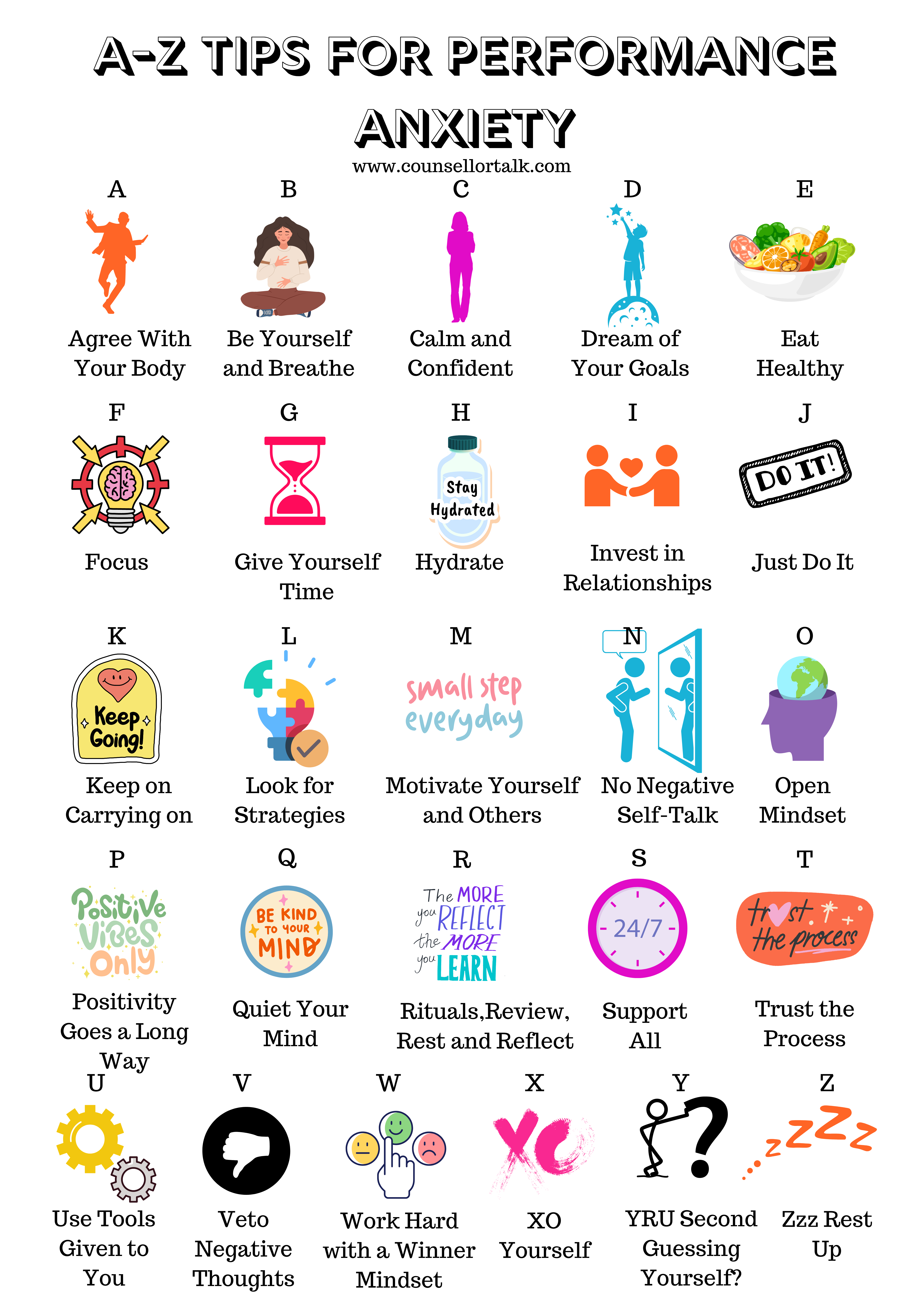
The Young Canadians offered a treasure trove of advice, such as:

  • Always be Positive, Affirmations Help, Anxiety is Really Excitement, Ask For Help, Address what’s making you stressed, Agree with your body, Assertive mindset, Act Kind.
  • Be Prepared, Breathe, Be Brave, Be The Best Version Of Yourself.
  • Calm Your Nerves, Confidence, Concentrate, Care for Yourself.
  • Don’t be Negative, Deep Breaths, Determination, Demolish Those Negative Thoughts.
  • Express Your Emotions, Eat Healthy, Engage Your Mind.
  • Fight Your Demons, Faith, Find A Distraction, Friends are There For You, Fear is OK, Finish What You Started.
  • Give It Your All, Get a Friend, Go For It! Growth Mindset.
  • Have a Calming Ritual, Have Fun! Hug a Friend, Hydrate.
  • Ignite Your Passion, Include Each Other, I Can Control Myself, Invest in Relationships, Imagine Success, Immerse Yourself, Inspire Others.
  • Just Be “John”, Just Do Your Best.
  • Kindness To Others, Keep Dancing, Singing, Playing, Keep Relaxing, Keep Focused.
  • Live, Love, Laugh, Love yourself, Lead The Way, Leave Anxiety Behind, Left Brain Shut-off.
  • Make Sure You Have Your Shoes, Meditate.
  • Never Back Down, No Fear: “The Young Canadians Are Here!” No over-thinking!
  • Optimistic Outlook, Open Mind.
  • Push Your Limits and Patience, Picture Everyone As People You Love, Prepare To Perform, Positive Mind and Thoughts.
  • Quit Quitting, Quiet Space, Quiz Yourself on Choreo
  • Respect Yourself and Others, Relax.
  • Sing, Dance, Play Your Heart Out, Snack so you won’t be Hangry! Shake it Off!, Sleep Well.
  • Trust Yourself, Trust The Process, Take A Walk, Talk To Someone You Trust, Take a Hot Minute.
  • U-have to Calm Down, U are Special, Use Tips and Tricks, U can do it! Uplift Each Other.
  • Victory is Yours, Voice Your Emotions, Veto Bad Thoughts.
  • We Love You, Work, Walk It Out, Warm Up.
  •  X-hale, X out Your Stress, X out Negative Thoughts.
  • You Got This, You Are Good Enough, YOLO Mindset.
  • Zero Fear, Get Your ZZZs (sleep), Zen Time, Zero Regrets.

Remember, when it comes to performance anxiety, you’ve got the tools! Believe in yourself and your abilities. Reach out if it becomes too tough. The next time you perform, use the tips that work for you to transform your own anxiety into excitement changing performance anxiety into a friend rather than a foe!

Helen MacKinnon and Susan Spellman Cann

Who Doesn’t Need A Counselling Skills Toolbox?

We all have our unique paths to walk, and sometimes, we could use a little help. That’s where Counsellor Talk can step in, providing the tools to navigate your emotions and experiences and help you to understand yourself better.

Being open to counselling as a way to transform your life is a good idea and we have loved helping those that have crossed our paths over the years.

Counsellor Talk Is written with counsellors in mind. However, teachers and those working with youth or adults can utilize the ideas too. Several handouts will work with people at every age level. There is no shortage of ideas to get those counselling ideas flowing to help others.

Who doesn’t need a counselling skills toolbox? A few ideas you can put in your toolbox are:

Just for Today

Start each day in a positive way. Accept yourself exactly as you are, knowing that you are enough.

When we celebrate our shared humanity and think of ways to help not only ourselves but find ways to help others and make the world a better place, we heal. All of us can do anything just for today.

Life is Better When…

We focus on gratitude rather than grievances. We treat ourselves with the same compassion and care that we give to others. So let go, embrace your flaws, and listen to the whispers of our intuition guiding you on your journey.

Challenge Yourself to…

Be more, do more, live more. Try something new, and learn to play more. Remember, by focusing on your strengths, you gain personal power. By reframing your thoughts, your worldview can change. By listening with an open mind and an open heart, you learn more.

Something You Might Need to Hear Today

You matter. You are a unique and valuable individual, worthy of love, respect, and acceptance. Like a butterfly emerging from its cocoon, you are continuously evolving and adapting to change.

Something I Need to Understand

Feelings aren’t facts. They are neither right nor wrong; they just are. Self-awareness is the first step towards personal growth. Exploring your thoughts, feelings, and behaviors can help you better understand yourself and your needs. Challenging negative thought patterns and cultivating positive affirmations can lead to a more positive outlook on life.

Remember, you are meant to be here; you have a purpose.

Well-being Tip

Treat yourself right; it’s time for a spa day so go ahead and take one. An economical version, relax in a bubble bath and let your worries unwind. Make time to have friends over for dinner. Enjoy the moments, make memories, and bring more joy into your day.

Rediscover simple pleasures and leave your phone behind. Find solace in simplicity; it’s your special place.

Final Thoughts

If you don’t like your story, rewrite a new chapter. Create the life you desire. Strive to thrive rather than just survive and shower yourself with self-love.

As Ronna Jevne says, “Hope is the small voice in our heart that says yes to life.” As your journey continues, remember, that you are not alone. Counsellor Talk, hopes you connect and collaborate with others every step of the way.

For more insights and tips, you can check out our book.

Counsellor Talk : Connecting Through Creative Counselling Techniques

It has been a process, to say the least in creating this book, but we are so happy it is here. So much learning as we did not hire anyone to help us. We look forward to sharing Counsellor Talk with you and are so grateful for all the input from others.

We believe our book is real and relatable, and we hope it will be truly inspiring. We invite you to explore a multitude of ideas that we hope will get your creative juices flowing.

Get ready to embark on a journey where we will share several tips, tools, and techniques to empower you in finding your path, and discovering what works best for you and your clients.

As psychologists, we understand the power of connection. The therapeutic alliance is the foundation upon which healing is built, the glue that binds us together in our shared humanity. In “Counsellor Talk,” we’re offering you the tools to deepen those connections, breathe new life into your practice, and embark on a journey where healing isn’t just a destination. You will use many of the ideas as jumping-off points to meet the needs of your particular clientele.

So, grab your favorite mug, brew a cup of your preferred beverage, (we prefer a cup of calming tea), and settle in. Let’s explore together, heart to heart. We hope you will rediscover the magic of counselling, not as a clinical exercise, but as an art— a place where ideas flow to meet the needs of those entrusted to your care. 

Throughout “Counsellor Talk,” you’ll find practical tips, creative exercises, handouts, and ways to integrate technology into your practice. From mindfulness techniques to expressive tools via the arts, from narrative therapy to using technological tools —we’re here to help you expand your toolkit, inspire you to think outside the box and embolden you to make a real difference in the lives of those you serve.

 “Counsellor Talk” isn’t just about the nuts and bolts of counselling—it’s about the heart and soul behind the practice. It’s about rediscovering the joy in your work and rekindling the passion for helping others which is the first thing that drew you to this field.

What inspired us to write “Counsellor Talk” was you—the counsellors, the school counsellors, the therapists, and the healers who devote their lives to helping others. This book has been over 30 years in the making, but life got in the way. So here we are finally sharing some of our ideas and inspiration with you by never giving up our goal and publishing our first book. The journey continues as we go on the road to support you with in-depth workshops based on our book Counsellor Talk.

As two psychologists with over 60 years of combined counselling experience, we wish to inspire the next generation of counsellors as well as rejuvenate those seasoned professionals.

In writing this book we hope to pass on our passion and love of counselling. It has been the best part of our professional lives.

Create An Intentional Ripple: The Smallest Good Deeds Matter

As Valentine’s Day approaches we often ramp up our intentional thoughts to gift someone we love something special. I want to point out one of my all-time favourite quotes,

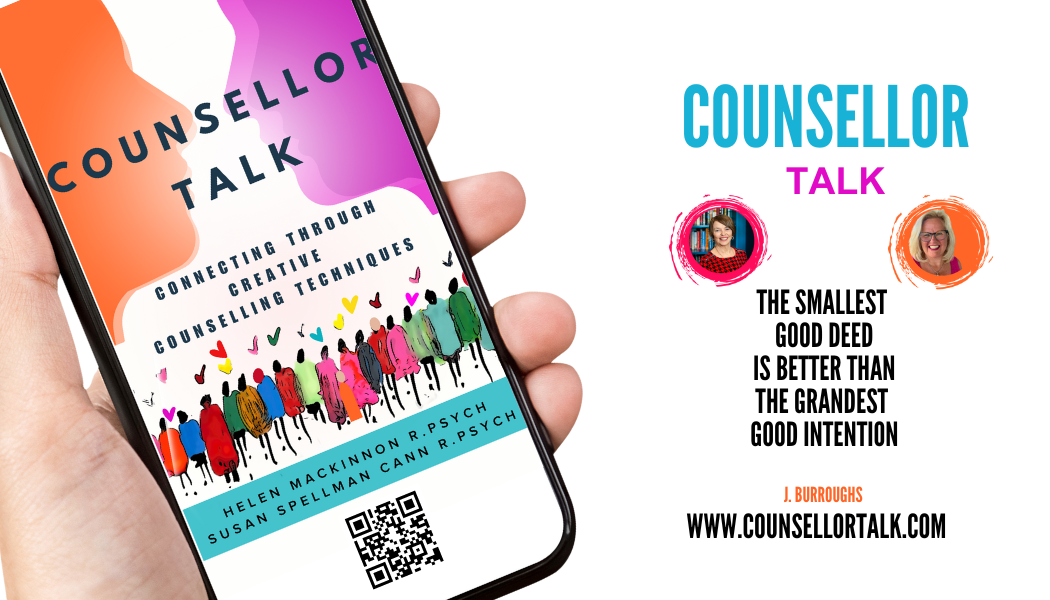
The Smallest Good Deed Is Better Than The Grandest Good Intention

J Burroughs

I’ve discovered that the most memorable moments are often born from the tiniest acts of kindness and I try my hardest to do them as often as I can not just on Valentine’s Day. A simple smile or “thank you” can brighten someone’s day, and a small favor can create a ripple effect of positivity.

One instance of a small gesture that stands out for me is when a student told me I had saved her life. I did not know the student, but she said I smiled at her every day in the hallway, and if not for that she was thinking about ending her life. The gesture was small, but the impact was immeasurable and I have never forgotten the moment she shared her story with me. It made me look at myself and what I do. As a result, I try as often as I can to do one small thing that I hope makes a difference for another human being.

Waiting for the perfect moment to do some grand gesture might never arrive. So start now … start today. Tell someone the difference they make in your life. You can send them a digital reminder.

Here are a few things to keep in mind about relationships that might help you based on John Gottman’s approach:

  1. The Magic Ratio:
    • Dr. Gottman talks about the importance of a 5:1 positive-to-negative interaction ratio. Are you practicing this interaction in all your relationships?
  2. Emotional Bank Account:
    • Think of your connections like a bank account, says Dr. Gottman. Regular deposits of emotional support build strong foundations. When and how often are you making deposits?
  3. The Four Horsemen:
    • Watch out for criticism, contempt, defensiveness, and stonewalling, warns Dr. Gottman. How are you paying attention to these in your relationships?
  1. Turning Towards Bids:
    • Bids for connection are like little invitations to intimacy. Respond positively to these bids. How often are you making these bids?
  2. The Love Map:
    • Dr. Gottman encourages building a detailed “love map” of your partner. Knowing your partner’s world intimately fosters a deep connection. Have you made a love map?
  3. Repair Attempts:
    • In every relationship, hiccups happen. Repair attempts are the remedy. Take time to apologize, make amends, and keep the connection intact. Who do you need to make repairs with today?
  4. Nurturing Fondness and Admiration:
    • Admire your partner’s or friends’ qualities; express fondness, Dr. Gottman advises. It’s like watering a plant; love in all relationships blossoms with care and attention. Who can you express fondness with today?
  5. Dreams Within Conflict:
    • Even conflicts have dreams and aspirations buried within, says Dr. Gottman. Unearth those dreams together for a richer understanding.
  6. Shared Meaning:
    • Relationships thrive on shared rituals and meanings. Create rituals in your life that matter to you and those you love.
  7. Small Moments, Big Impact:
    • I agree with Dr. Gottman, that small moments matter the most. Cherish the everyday connections; they make a difference for you and those you care about. Check out The Small Things Often Podcast.

So go ahead not just in your love relationships, but in your day-to-day connections with people take the time to find ways to do a small good deed. You will be glad you did.

  • Leave an extra tip.
  • Tell the manager their employee is doing a great job.
  • Buy a lotto ticket for someone for no reason.
  • Send a message, postcard, or letter telling someone how much you appreciate them.
  • Offer to help an elderly person do something.
  • Spend more time with those you love.

Live MoreLaugh MoreLove MoreBe More intentional in your small deeds starting today.

10 Anti- Valentines Day Ideas. It’s Not Just About Romance You Know

“The best and most beautiful things in this world cannot be seen or even heard but must be felt with the heart.” – Helen Keller

Valentine’s Day is typically associated with romance and couples. But what about those who prefer to celebrate in an unconventional way or perhaps not all? There’s no rule saying you have to stick to the norm. Here are 10 Anti-Valentine’s Day ideas for you to consider.

1. Self-Love Day

Why not celebrate the most important person in your life – you? Use this day to treat yourself. Have a spa day, go shopping, read a book, or watch your favourite movie. Give yourself the love and attention you deserve. Try leaving positive affirmations on your mirrors or on your fridge. They can be little love notes to yourself.

2. Friends’ Gathering

Who says Valentine’s Day is only for couples? Organize a get-together with your friends. Connect and put away those phones. Play games, have a movie marathon, or just chat and enjoy each other’s company. Call an old friend and reconnect. Friends just make the world a better place. Write a note, postcard, or letter to your friend telling them how they have made a difference in your life.

3. Adventure Day

Do something daring and exciting. Go hiking, go for a walk, discover new places and things, try a new sport, and remember to invite a friend. The adrenaline rush will make it a day to remember.

4. Charity Work

Spread the love by volunteering. Helping others can be a rewarding way to spend the day.

5. Learning Something New

Take a class or workshop in something you’ve always wanted to learn. It could be painting, coding, cooking, or anything that interests you.

6. Pet Love Day

If you have pets, spend time being silly with them or take them for a nice stroll. They provide unconditional love and deserve to be celebrated too.

7.Get Back to Nature Day

Escape the city and spend the day in nature. Go to the mountains or for a long walk in a park or simply enjoy the tranquillity.

8. Workout Day

Hit the gym or go for a walk or run. Physical activity releases endorphins, the feel-good hormone, and will make you feel great.

9. DIY Day

Get creative and make something from scratch. It could be a piece of furniture, a painting, a card, a digital scrapbook or a home decoration.

10. Counsellor Talk

Visit a counsellor or therapist. Discuss your feelings, fears, or anything that’s on your mind. It’s a great way to take care of your mental health.

Remember, whether you’re single or in a relationship, Valentine’s Day is what you make of it. So why not make it a day that celebrates you and the things you love?